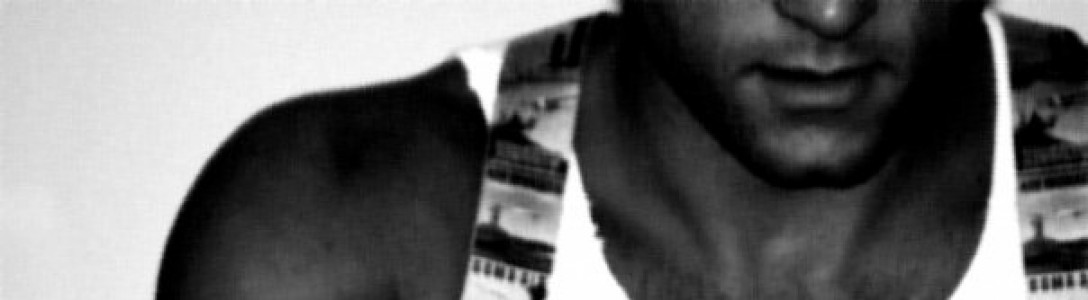
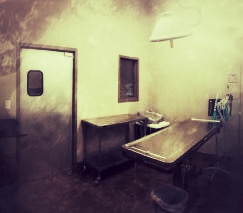
I sat in my underwear on a cold steel table and clawed at the inflamed, pink skin on my chest, coming off in clumps. The good Dr. Ayallah stuck the hypodermic needle into the vial and drew out a muddy-red cocktail. Tucked in the furthest corner of the basement in the School of Medicine, the examination room was small and quiet with a single observation window. I hope no one is staring at me through that window, I thought. This tiny room smelled like grandpa’s old shed of rakes and shovels: writhing worms; rotten, wet grass clippings; recycled air. The doctor stood too tall for the room, his pointy chin tucked into his chest, his brown, balding head scraping the ceiling. He hadn’t said a single word, or even so much as looked at me.
But there I was, Ben “Isacson,” hoping they have a better handle on medicine than spelling people’s last names, half-naked in Room 29 of the Hayes Building at 8:00 p.m. on October 30th, as the email had instructed. And there he was, Dr. Ayallah, a visiting professor and dermatologist, extracting his “ingenious remedy” for my disgusting skin condition. And I’m feeling so goddamn desperate…
Now I was alone with this creep.
Dr. Ayallah returned the empty vial to his black bag, and lifted the needle toward dim light, flicking the syringe with a bony finger while squeezing out a bit of the medicine.
“Is that blood?” I asked with a nervous chuckle. Then there was this heavy silence, like when you bow your heads at a funeral; and following it, an awful thrashing noise from elsewhere in the basement. It had to be a kid, probably my age, screaming at some torture, and then a jarring clang, as though a steel table had been overturned.
Eyes wide, I jumped from the table, but the “good” doctor was already turning, gangly arm swinging in a wide arc, the needle slicing through dank air. It jabbed me in the neck, and I assume his aim had been true. Dr. Ayallah took one step backward, as though to formally present the proud grotesqueness of his disfigurement, and there, I saw him for the first time.
His eyelids were red and swollen and stitched closed with wire. Like the flap of a tent that opened to dark skies, his bottom lip fell forward, and the corners of his mouth stretched into a wide, vacuous grin. From the hole in his face dribbled the smell of something forgotten: bits of fish in the kitchen sink; picked flowers clinging to an inch of moldy water on their final day; an infected blister between sweaty toes. Ashen skin peeled in clumps from his neck—like mine on its worse day, but multiplied by a thousand—and I couldn’t help but wonder: is this what I’m soon to become?
He snatched up his black bag and made briskly for the door, his head dragging across the ceiling. When the door slammed behind him, I was left alone for a moment with my twitching mouth and limbs, gawking at the messy sheets of his scalp clinging to the concrete above. Then the door opened, just a bit, and a gray, fleshy hand holding a birdcage crept in. It set the cage upon the floor and retreated, leaving soggy chunks of skin amassed upon the cage’s handle. Behind bars sat a small, yellow bird. The head cocked in robotic inquisitiveness, a single black eye examining my half-naked body. Its soft song drifted through its prison walls, and for whatever reason, in that moment, I only wanted to eat the innocent creature within—or at least to bite the head off and end its beautiful song. And so with legs of lead I lurched toward it, and then I spotted… him.
Perhaps it was he that I had heard earlier, the poor kid, now reduced to a goddamn monster peering at me from the observation room. Open-mouthed, he stared at me with bloodshot eyes, panting like a cornered, rabid dog. The dim lamplight above me flickered and faded, and I could hardly see him through the glass. I moved closer, with a thickness in my throat that I could not swallow. There I found him clawing at his own skin—his neck and bare chest—in a most unsettling and contagious way, for I then dug dirty nails across my collarbone and cried out in pain. The bird’s sweet, happy song flitted all around. The poor soul beyond the window so quickly became my enemy, as he stood there crying, wheezing—wishing for a swift death that perhaps I might bring him.
The bird’s call rang from the steel table and grew angry in the echo.
I lunged at the poor kid beyond the glass. My head went first at him, shattering that which divided us, and I saw close his open, weeping mouth. I bit into it, and blood spurted around me. I clawed and gnawed and scratched. I hated this kid without mercy as the bird’s love song danced upon pools of blood. We ate at one another’s bodies until both fell silent, exhausted, dying.
The next thing I remember is stumbling to my apartment, fully clothed, body throbbing with pain. Whatever the hour, the campus was dead, and not a single soul crossed me. Curving sidewalks and pulsing lights teased me as though I was drunk, but I remember incredulously inspecting my shaky hands, but any wounds I had sustained appeared healed. This was a dream?
The curse had all but worn off by the turn of my key, and I went into my unkempt, single dorm room with the idea that I’d much prefer living with a skin condition than enduring such hallucinations. That’s when I felt the pinch in my forearm. I rolled up my shirtsleeve and yanked free the shard of glass lodged in my muscle. Thick blood trickled down grayish skin to my elbow. I held up this piece of glass, through which I had indeed seen the monster made by the good “doctor.” But there I saw only my reflection: a shard of mirrored glass and a bleeding, rotting monster within, and the faraway song of a yellow bird.
 neuspaper